ADAMTS18 regulates ECM turnover via fibronectin cleavage
First published November 4, 2025 • Last modified on July 26, 2026 • 2 min read • 309 words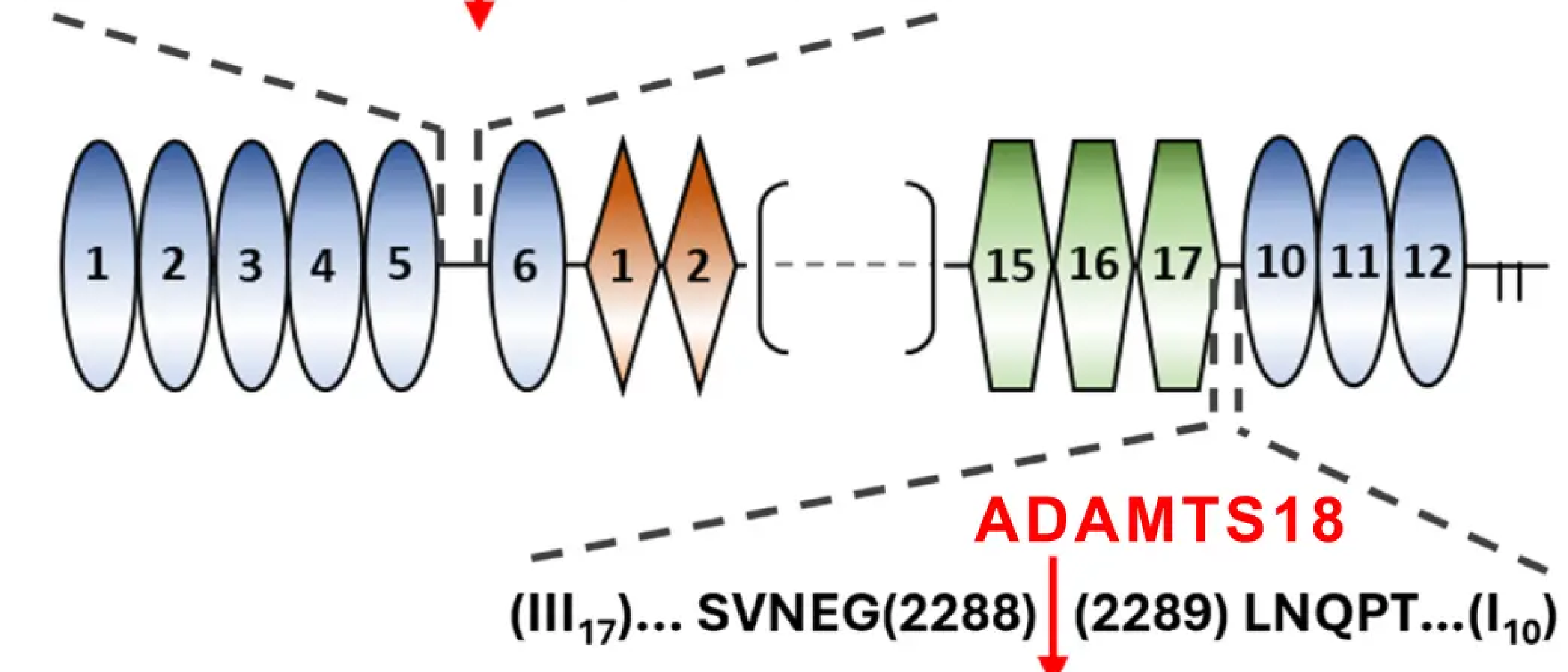
The maintenance of the specialized blood vessels in intestinal villi had been the topic of a Nature Communications paper from the Petrova lab ( https://doi.org/10.1038/s41467-022-31571-2 ). Maintaining the polarity of the nutrient-absorbing vessels required a differential exposure to VEGFA, which was maintained by specialized cells producing the right amount of fibronectin. The previously orphan ADAMTS18 was the protease that appeared instrumental in the proteolytic maturation of fibronectin. Now, a publication from the University of Eastern Finland analyzed the ADAMTS18 fibronectin connection in more detail: https://doi.org/10.1016/j.jbc.2025.110844 . Fibronectin normally does not exist as a single molecule, but it forms fibrils that are essential building blocks of the extracellular matrix. ADAMTS18 removes a critical part of the fibronectin molecule, thus preventing it from forming fibrils. This establishes ADAMTS18 as an important player not only in endothelial cell biology, but potentially in many other contexts in which fibronectin-containing extracellular matrix is involved. Fibronectin, as a major component of the provisional matrix, is crucial during wound healing and in the ECM maintenance of organs like the lungs. Consequently, there are many interesting avenues opening up to look at additional specific functions for ADAMTS18. Congrats, Maria, for this important contribution to our understanding of another ADAMTS family member!
PS: I tried to use AI via my phone on the bus trip to the Lammi Research Station to generate the image that goes along with this blogpost. It took me one hour and about 10 prompt attempts before Manus AI got it right. It was constantly having regression errors when improving upon a good, but not good enough, version. Manus created a Python script for every image manipulation (cutting away the unnecessary parts, erasing the panel letter “D”, resizing the canvas, scaling, etc.). A reasonably good human does this in about 5 minutes using e.g. Inkscape . BTW here is the original image: https://ars.els-cdn.com/content/image/1-s2.0-S0021925825026961-gr9_lrg.jpg .