Kapa HiFi excels, Phusion works sort-of, Q5 and Platinum SuperFi disappoint

First published December 2, 2016 • Last modified on July 25, 2026 • 2 min read • 276 words
My last NEBuilder assembly got stuck because I couldn’t get two of the PCR reactions to work.
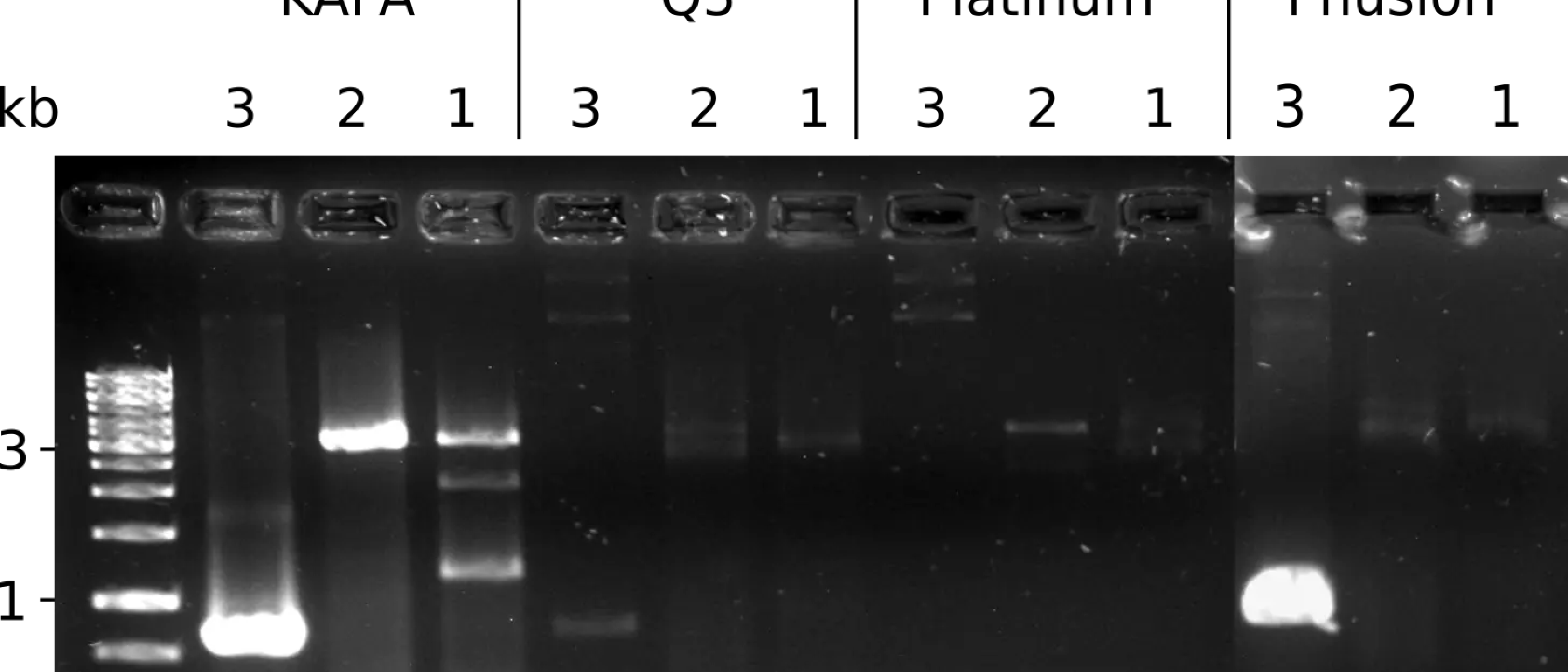
Kapa HiFi excels, Phusion works sort-of, Q5 and Platinum SuperFi disappoint
Image by Michael Jeltsch
My last NEBuilder assembly  got stuck because I couldn’t get two of the PCR reactions to work. I needed one small fragment and two ~3-kb-fragments. I needed to insert a 2A-sequence in between the small and one of the 3-kb-fragments and thus added the necessary sequences as tails to the primers. The template was not especially GC-rich, nothing too complicated, but only the small fragment did amplify in my first attempt. When also my second attempt failed to amplify the 3-kb-fragments, I decided to try out some alternative polymerases. For cloning purposes, I have been using exclusively Phusion High Fidelity DNA polymerase (from New England Biolabs  or from ThermoFisher  ) for the last years, but maybe there was something better and more robust? I received three different free samples for testing: KAPA HiFi HotStart  , NEB Q5® High-Fidelity  and ThermoFisher Platinum SuperFi™  . My graduate student did the PCRs yesterday and I ran the gels today. From the gel quality, you can see that I don’t have much routine anymore, but the overall results are quite clear and in the future, our go-to polymerase for tricky templates will be KAPA. I think KAPA’s proofreading capabilities are a bit below Phusion, but I do not care if 2% instead of 0.5% of the DNA products contain a mutation.In the attached PDF file, you can see, that my grad student included two more samples for the Phusion polymerase, where she used the same conditions, but a different template (supercoiled plasmid instead of linear DNA). Surprisingly, the Phusion polymerase did a much better job to amplify from supercoild DNA than from (the same) linear DNA; I cannot explain that…