Who does still restriction enzyme cloning?
First published June 27, 2024 • Last modified on July 18, 2026 • 4 min read • 648 wordsRestriction enzymes cleave DNA at specific sites and thus enable — together with DNA-ligating enzymes — the molecular cut-and-paste operations that still underlie most of today’s recombinant DNA constructs.
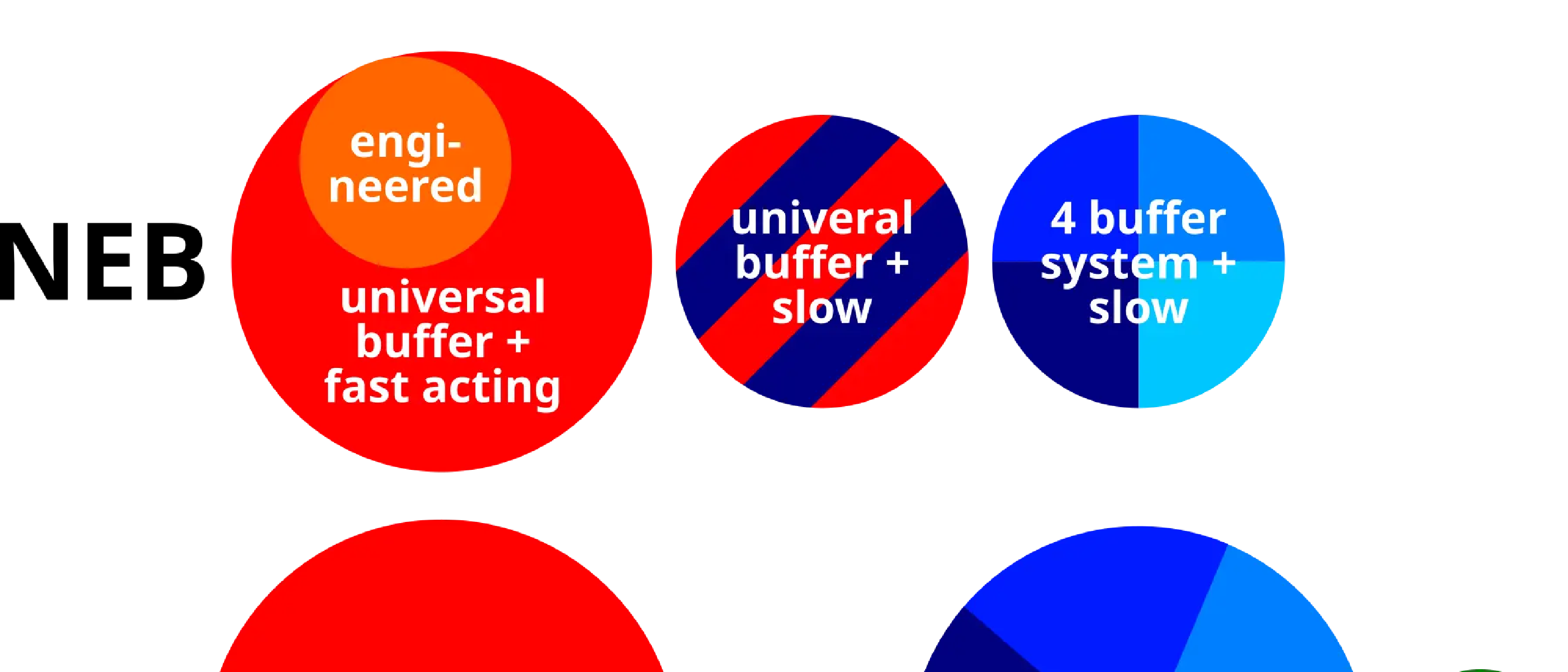
ThermoFisher does not provide enough information about its enzymes to use them as equals in a mixed environment with enzymes from vendors that have full transparency, such as New England Biolabs (NEB).This close-mindedness has led ThermoFisher to invent their own definition of restriction enzyme activity based on a 5-minute window, which makes straightforward comparisons with competitors’ enzymes impossible since they use the standard 1-hour window. Since enzymes survive for different amounts of time in a reaction, and since ThermoFisher — unlike NEB — does not provide any data about their enzymes’ survival times, no meaningful comparison is possible. One wonders whether the only purpose of the new unit definition was to prevent any comparisons. That alone should be sufficient reason to avoid ThermoFisher like the plague, but there is more. In 2014 I pointed out that after acquisition of Fermentas by ThermoFisher, not a single new FastDigest enzyme had been added to their product line. This statement is still true a decade later (and it is equally true for conventional restriction enzymes). Innovation concerning restriction enzymes has also slowed at NEB, but since 2015, NEB added some five HighFidelity enzymes (ApoI, BbsI, BclI, BsiWI, BstZ17I) as well as a few conventional restriction enzymes to their portfolio.The biggest issue I see with ThermoFisher’s policy of silence. hardly anyone knows that they sell isoschizomers under the prototype enzyme’s name. While they are upfront about the use of isoschizomers in their non-FastDigest lineup, they do not disclose the identity of their FastDigest enzymes. Many of the FastDigest enzymes are isoschizomers according to
Arvydas Janulaitis
, the former CSO of
Fermentas
, the company that developed the FastDigest system before they were swallowed by ThermoFisher in 2010.In a
recently updated flyer
, Thermo Scientific tries to paint a picture of superiority over NEB but only manages to fool cloning novices. In their infographic, they try to emphasize the simplicity of the buffer choice within ThermoFisher’s restriction enzyme portfolio and compare it to NEB’s portfolio.However, they ignore their 190 conventional enzymes that are not FastDigest buffer-compatible (and this group includes important enzymes, e.g. the “GoldenGate” type IIS enzyme BsmBI). To correct the record, I have made a better graphical comparison between ThermoFisher and NEB, which is the main image of this blog post.Even my comparison is optically misleading since it does not account for redundant enzymes, which ThermoFisher features a lot due to its aggressive acquisition strategy. In this comparison, it looks as if ThermoFisher offers more different enzymes, but this is not the case at all. Accounting for redundancies, NEB has 257 different commercially available restriction enzymes, while Thermo Fisher has only 209. I did not count myself but relied on the newest enzyme description file from the best cloning planning and documentation software
SnapGene
.In 2014, I complained that their Fast Digest buffer has a proprietary composition, and when I checked today, that was still the case. There has been zero progress at Thermo Fisher’s restriction enzyme front: no innovation, no increased transparency.